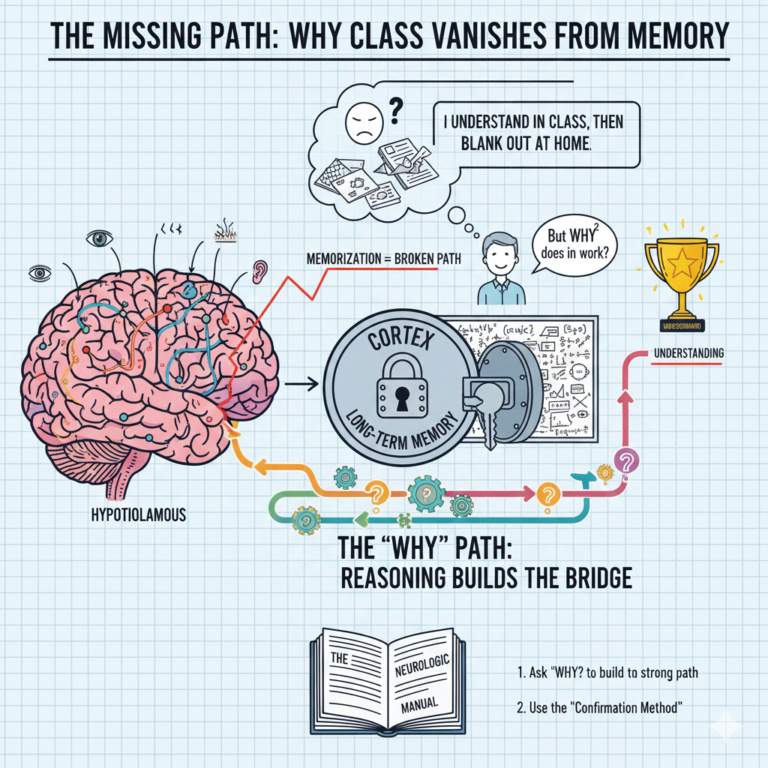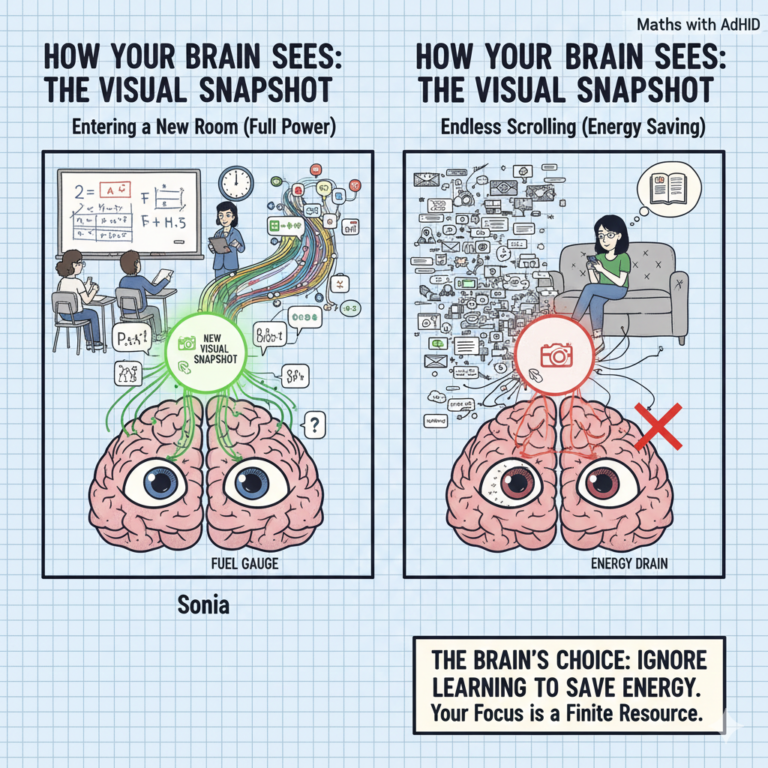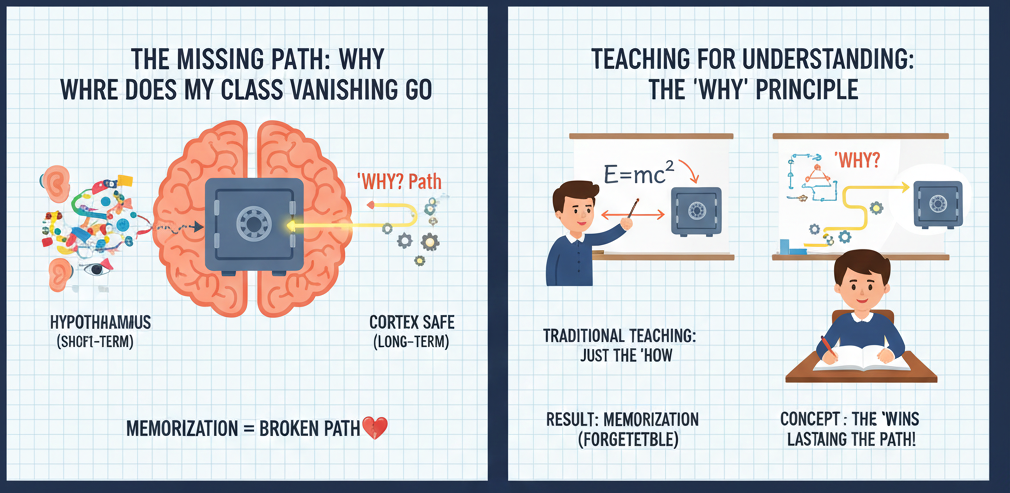
I understand in class, then blank out at home.
🧠 The Information Vanishes: Where Does My Class Learning Go?
If you can’t explain it later, you didn’t learn it. You memorised a surface pattern. The reasoning never reached the cortex.
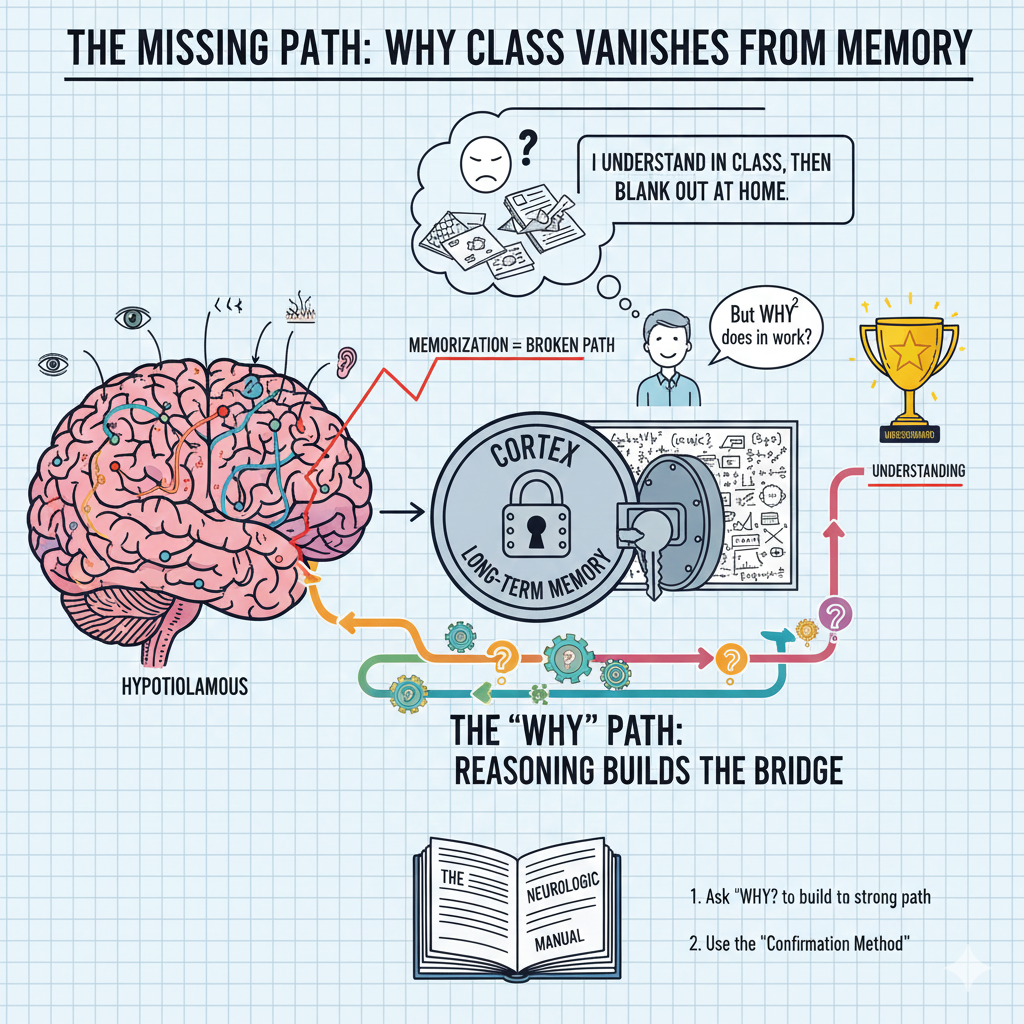
1. The Real Problem: The Missing Path (Hypothalamus→Cortex)
The Pain: You sit in class, the teacher speaks, it all makes sense. You feel smart! But the moment you sit down to homework, your mind is blank. You haven’t truly learned the concept; you’ve just memorized the teacher’s sequence.
Blanking out at home is not a failure.
It is a signal that the learning loop never completed.
In class, you follow the teacher’s steps. You recognise the pattern. The answer feels “right.”
But recognition is not understanding.
Recognition happens in the hypothalamus.
Understanding happens in the cortex.
If the teacher presents formulas without reasoning, the information never transfers.
You leave the room believing you “got it,” but the neural path was never formed.
That is why the concept collapses the moment you sit alone with a blank page.
This is not your fault.
This is an instructional gap.
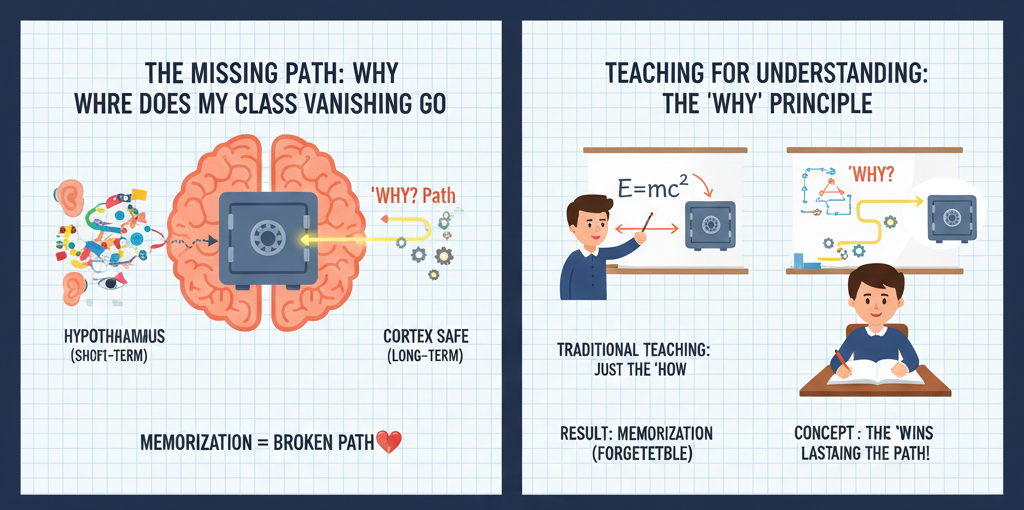
The Science: You caught the information (the pattern) in the immediate processing center (Hypothalamus), but the path to send it to the long-term storage (Cortex ‘Safe’) is missing. The path is built by reasoning, not repetition.
The Result: You can’t replicate the pattern because you don’t know the reasoning behind it. As a great mind said, “If you can’t teach something simply, you haven’t understood it either.” The failure is in the path, not in your capability.
THE ROOT ISSUE: PATTERN TRACKING WITHOUT LOGIC
ADHD students are often excellent at tracking surface patterns:
the shape of the solution, the rhythm of the teacher’s steps, the visual cues.
But unless the teacher explains:
• why this step works
• why the opposite step fails
• why the formula exists at all
…the brain stores nothing permanent.
Pattern ≠ understanding.
Pattern is temporary.
Reasoning is permanent.
2. Your Power Move: Ask the Ultimate Question
Since you can’t rely on the teacher to always provide the conceptual path (the “Why”), you must build it yourself.
The Teacher’s Role: Your intuitive ability to “catch the pattern” is a gift. A good teacher will solve the hardest questions in class to demonstrate the concept’s full range, leaving the easy ones for you to solidify at home. If your teacher doesn’t do this, you must adjust your home study plan.
During Class (Your Highest Priority): Never settle for just the formula or the procedure. You must ask: “Why does this formula work?” or “Why did we use this step and not the previous one?” Take notes on the answer to “Why,” not just the steps to “How.”
WHY HARD QUESTIONS SHOULD BE DONE IN CLASS
When a teacher only solves easy examples, the students never see the real engine of the concept.
Hard questions expose the hidden rules.
Hard questions require logic, not memorisation.
Hard questions force the teacher to reveal how they think.
Solving the difficult problems in class means you go home with the full picture, not fragments.
If this does not happen in your classroom, you need a method to compensate.
3. Home Study Strategy: Working Backwards to Build the Path
When you study at home, you must prioritize building the path over simply getting the correct answer.
WHAT TO DO IF YOUR TEACHER DOESN’T TEACH THE “WHY”?
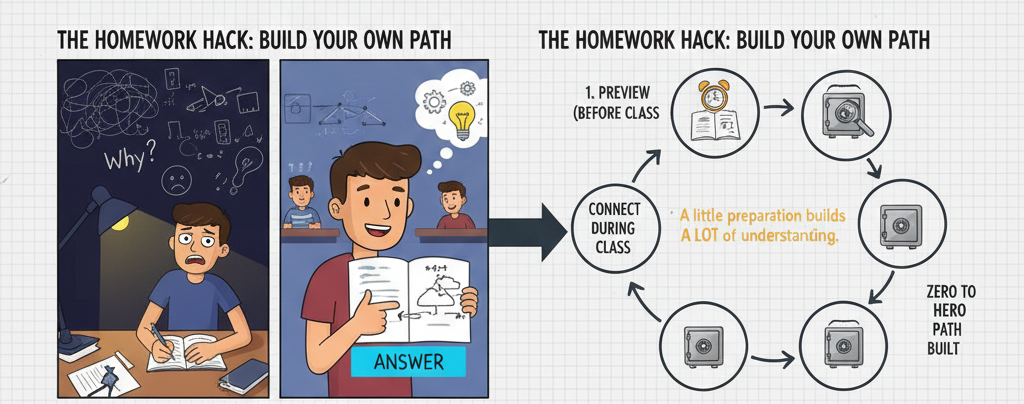
1) Arrive with a preview—even if you don’t understand it.
Look at the examples before class.
Your brain becomes familiar with the “puzzle board.”
You anchor the shapes, ideas, vocabulary.
Then class feels like adding meaning to something you’ve already seen, not decoding from zero.
This small preview increases comprehension dramatically.
Step 1: The Confirmation Method (Build the Path)
- The Method: Before solving a problem, put the correct final answer into the question first.
- The Goal: Now, solve the problem, not to find the answer, but to see how the final answer is achieved. This process forces your brain to focus on the structure and reasoning, confirming that the concept makes sense.
- Action: Solve 10 questions using this method. If the concept feels solid, proceed to Step 2.
Step 2: The Base Check (Identify the Gaps)
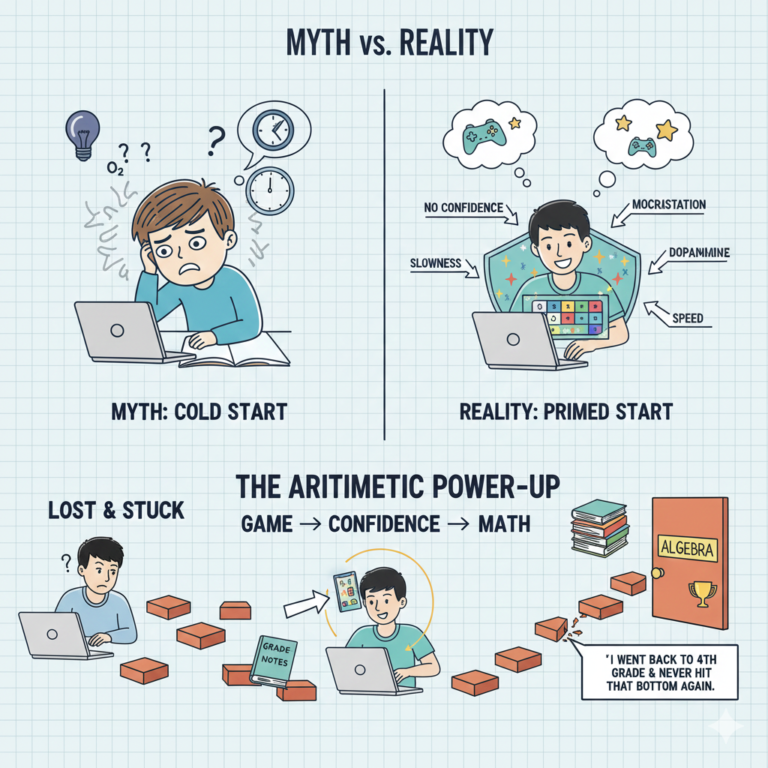
- The Challenge: If Step 1 feels difficult or confusing, you are missing a piece of foundation. You are looking at Algebra but missing a core Arithmetic concept.
- Action: Immediately stop and check the base concepts required for the current topic. A building cannot stand if the foundation is missing.
Step 3: The Preview Hack
The Result: You don’t have to understand it, but when the information hits your brain in class, the “puzzle pieces” look clearer. You have a conceptual scaffold, which makes finding the path to the Cortex much easier than starting from zero.
The Method: Prepare your brain ahead of time. Before a new lecture, preview the material. Read the chapter titles and look at the first few examples.
THE STUDY RULE
If you understand something, you can teach it simply.
If you cannot teach it, you did not understand it.
You only mirrored the teacher’s pattern.
Your goal is to uncover the reasoning engine, not the steps.
Have a quick question about a guide or press inquiry? Send a focused email: sonia@mathswithadhd.comSocial Media
Follow me for daily tips, encouragement, and reminders about the Brain Wave Barrier!
I understand in class but forget at home, blanking out at home after class ADHD, why I understand lessons but can’t do homework, ADHD understand in class forget later, why learning disappears after school, I get it in class but can’t apply it at home, ADHD memory gap between class and home, why concepts make sense then vanish, understand maths in lesson but stuck alone, ADHD brain losing information after class, why I can’t recall what I learned in class, class understanding but homework confusion ADHD, why learning doesn’t transfer from class to home, ADHD working memory problems after lessons, understand teacher explanation but can’t solve alone, why knowledge doesn’t stick after class, ADHD pattern recognition without understanding, blank mind when studying alone ADHD, why I need the teacher present to understand, ADHD learning collapse outside classroom